
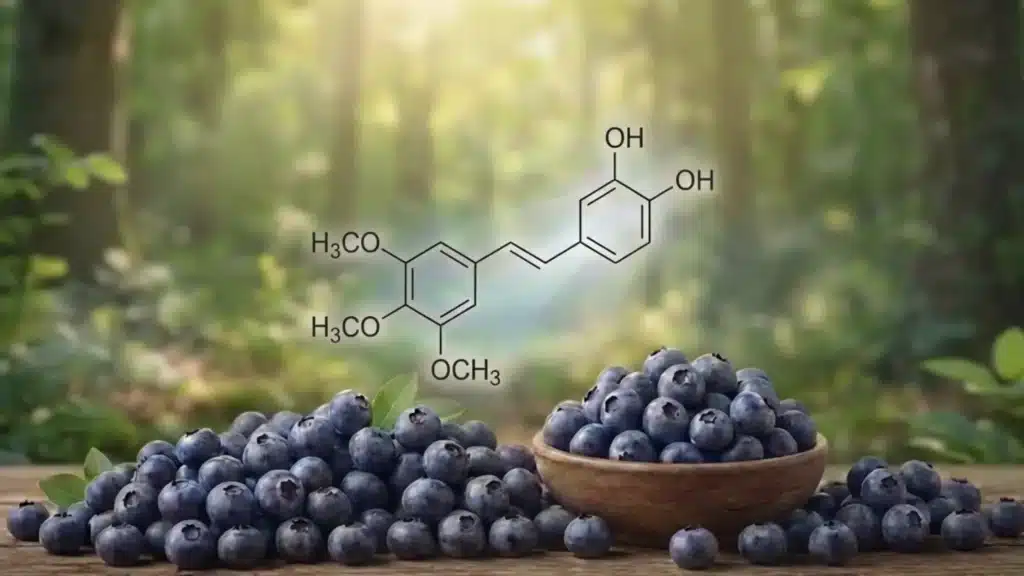
Pterostilbene (pronounced terr-oh-STILL-bean) is a naturally occurring polyphenol found in blueberries, grapes, peanuts, and the bark of the Indian Kino Tree. It belongs to the stilbenoid family, the same chemical class as resveratrol, and has attracted serious scientific attention over the past decade for its antioxidant, anti-inflammatory, and potential anti-aging properties.
What sets pterostilbene apart structurally is the presence of two methoxy groups where resveratrol has hydroxyl groups. That seemingly small difference has major implications for how the compound behaves inside the human body, particularly around absorption and how long it stays active in your system.
- Pterostilbene is a highly bioavailable polyphenol and a close structural relative of resveratrol.
- Thanks to its methoxy groups, pterostilbene boasts an oral bioavailability of approximately 80%, compared to roughly 20% for resveratrol.
- Its lipophilic nature allows it to cross the blood-brain barrier easily, making it an excellent candidate for cognitive and neurological support.
- Pterostilbene and resveratrol target complementary longevity pathways and are often taken together for comprehensive cellular defense.
- Clinical studies generally safely utilize doses ranging between 50 mg and 250 mg per day.
What Is Pterostilbene?
Pterostilbene operates as a powerful antioxidant naturally derived from botanical sources. While standard resveratrol has dominated the longevity conversation for years, scientists have increasingly turned their focus to pterostilbene due to its robust metabolic stability. Because it is highly lipophilic (fat-soluble), your body absorbs it quickly and utilizes it efficiently before it can be broken down and excreted.
Pterostilbene vs. Resveratrol: What the Research Shows
The comparison between pterostilbene and resveratrol comes up constantly, and for good reason. They are closely related, share many biological targets, and are often sold side by side. But they are not interchangeable.
Bioavailability: The Biggest Difference
This is where pterostilbene pulls ahead most clearly. Studies have shown that pterostilbene has an oral bioavailability of approximately 80%, compared to roughly 20% or less for standard resveratrol. The gap exists because resveratrol is broken down rapidly by the liver and intestines during what is known as first-pass metabolism. Much of what you swallow never makes it into your bloodstream in its active form.
Pterostilbene’s methoxy groups make it significantly more lipophilic, meaning it crosses cell membranes more efficiently, resists rapid breakdown, and maintains a longer half-life in the body. In practical terms, more of it reaches the tissues where it can do its work.
Blood-Brain Barrier Penetration
One area where resveratrol vs. pterostilbene research favors pterostilbene is neuroprotection. Its fat-soluble structure allows it to cross the blood-brain barrier more effectively, making it a more practical candidate for cognitive support applications. Research has suggested potential benefits for reducing neuroinflammation and supporting memory-related pathways, though most of the strongest evidence is still from preclinical studies.
Antioxidant and Anti-Inflammatory Activity
Both compounds activate SIRT1, a protein associated with longevity pathways, and both show antioxidant and anti-inflammatory activity. Studies suggest pterostilbene activates SIRT1 more potently per unit dose, in part because more of it reaches systemic circulation. It has also shown superior ability to inhibit NF-kB, a signaling protein involved in the body’s inflammatory response.
Cardiovascular and Metabolic Effects
A randomized, double-blind, placebo-controlled trial published on PubMed found that pterostilbene reduced both systolic and diastolic blood pressure in adults at higher doses. Both compounds have shown benefits in studies looking at metabolic health, insulin sensitivity, and lipid profiles, though results are mixed and the research base for resveratrol in humans is currently broader.
| Feature | Pterostilbene | Resveratrol |
|---|---|---|
| Oral Bioavailability | High (~80%) | Low (~20%) |
| Half-Life | 105 minutes | 14 minutes |
| Blood-Brain Barrier Penetration | Excellent (highly lipophilic) | Moderate |
| Primary Strengths | Neurological support, systemic distribution | Gut microbiome health, vast clinical data |
Are They Better Together?
Pterostilbene is not a substitute for resveratrol. They differ in function and may target complementary pathways. Some researchers believe resveratrol has unique benefits in the gut microbiome, while pterostilbene handles more systemic and neurological activity. Many people who take one also consider the other for a more comprehensive approach to longevity support.
Key Potential Benefits of a Pterostilbene Supplement
Based on the available research, pterostilbene supplementation has been studied in connection with several pathways:
- Cognitive support: Preclinical studies show improvements in memory and learning in aged animal models. Its superior blood-brain barrier penetration makes it a promising compound for neuroprotection research.
- Cardiovascular health: Studies suggest potential support for healthy blood pressure and antioxidant protection of cardiac tissue.
- Antioxidant defense: Pterostilbene activates the Nrf2 pathway, which regulates the body’s own antioxidant enzyme production, offering a compounding effect beyond just scavenging free radicals directly.
- Metabolic health: Activation of the AMPK/SIRT1/PGC-1a axis may support mitochondrial function, energy metabolism, and healthy glucose regulation.
- Anti-aging pathways: Sirtuin activation, which pterostilbene drives potently, is a central mechanism in several leading longevity models.
Pterostilbene Dosage: What Do Studies Use?
A widely cited human safety trial found pterostilbene to be generally safe at doses up to 250 mg per day. Clinical studies have used a range of doses depending on the target outcome:
- 50 mg/day is a common starting point used in metabolic studies.
- 100 to 250 mg/day is the range most frequently cited across available research.
- 250 mg/day is the upper dose verified as well-tolerated in a human safety study over 6 to 8 weeks.
What Makes the Best Pterostilbene Supplement?
Purity and quality matter more with polyphenol supplements than many buyers realize. Here is what to look for:
- Purity level: The active compound should be trans-pterostilbene, the biologically active isomer. Look for 99% purity and a confirmed CAS number (537-42-8).
- Independent lab certification: Third-party testing by an accredited US laboratory verifies that what is on the label is actually in the capsule. This is not standard across the industry.
- No excipients: Many manufacturers add fillers, binders, and flow agents that serve no health purpose and may interfere with absorption. A clean supplement contains only the active compound in a vegetarian capsule.
- Micronization: Smaller particle size improves dissolution and absorption, particularly for lipophilic compounds like pterostilbene.
- Transparent manufacturing: Made in the USA under accountable manufacturing practices.
Why Researchers Choose Mega Resveratrol
Mega Resveratrol’s 99% Pure Trans Pterostilbene meets each of those exact standards. It is 99% pure trans-pterostilbene, purity-certified by an independent US laboratory, excipient-free, gluten-free, and fully vegetarian. It is micronized for optimal absorption and manufactured in the USA.
Over 300 research institutes worldwide have chosen Mega Resveratrol products, and more than 50 peer-reviewed studies have been published using them. That kind of trust from the research community speaks to what pharmaceutical-grade quality actually means in practice.
You can browse the full range of polyphenol and longevity supplements by visiting our product catalog.
Frequently Asked Questions
Can I take pterostilbene with resveratrol?
Yes. They are perfectly compatible and may complement each other. Pterostilbene handles systemic and neurological activity well due to its superior bioavailability, while resveratrol may contribute unique benefits in gut microbiome health. Many researchers and longevity-focused individuals take both compounds simultaneously.
Is pterostilbene better than resveratrol?
For bioavailability and blood-brain barrier penetration, pterostilbene has a clear advantage. Resveratrol, however, has a deeper human clinical research base. Depending on your goals, one may suit you better, or using both together may be the optimal approach.
When should I take my pterostilbene supplement?
Taking it with a meal that includes healthy fats may optimize absorption due to its fat-soluble nature. Consistency matters significantly more than the specific time of day.
How long before I see results?
The clinical studies demonstrating measurable effects typically run for 6 to 12 weeks. Polyphenol supplements support complex biological pathways over time. They are designed for long-term foundational health and are not intended for immediate or acute effects.
